
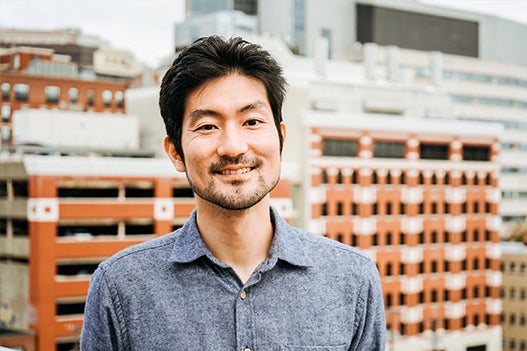
The lab of Keisuke Ishihara, assistant professor of computational and systems biology, School of Medicine, University of Pittsburgh, announced Oct. 14 that it has been selected as a recipient of the Google.org Impact Challenge: AI for Science.
Pitt will receive $2.25 million to support the Ishihara lab’s use of geometric artificial intelligence (AI) and human cardiac organoids to discover the genetic switches that could one day allow the human heart to regenerate after injury.
The Ishihara lab is one of 17 organizations selected globally from more than 3,000 applicants across 30 countries to share $36 million in funding.
Heart attacks and other cardiac injuries affect millions of people each year, and the adult human heart can’t regrow lost muscle. Some species can regenerate their hearts, but the genetic programs behind this ability remain poorly understood.
Working with the labs of Melanie Weber at Harvard University and Hattie Chung at Yale School of Medicine, the Ishihara lab at the University of Pittsburgh will pair a new geometric AI method with human cardiac organoids, lab-grown models of heart tissue, in a “lab-in-the-loop” approach. The AI will compare more than 2.7 million single-cell profiles across species to pinpoint the regulatory genes that regenerative species use and humans lack.
Those predictions will be tested in injured organoids using large-scale genetic screens, and the results will be fed back to sharpen the AI’s next round of predictions. With these resources, researchers will be able to move from cross-species discovery to experimental validation in human tissue.
“This grant lets us ask a question that no single lab could answer alone: What separates a heart that regenerates from one that scars, and can we switch that program on in human tissue? By combining AI with human cardiac organoids, we can search for these switches at a scale that was not possible before and share everything we learn openly so that other researchers can build on it,” said Ishihara.
“We’re at an extraordinary moment for science, as advances in AI open up new possibilities for discovery that were difficult to imagine just a few years ago,” said Leslie Yeh, director of scientific progress, Google.org. “The Ishihara lab at the University of Pittsburgh is bringing together AI and deep scientific expertise in ambitious, creative ways to address some of humanity’s most important questions. We’re honored to support their work as they apply AI to find the genetic switches that could restore heart regeneration and push the boundaries of scientific discovery and turn breakthrough ideas into real-world impact.”
Media contact: HSnews@pitt.edu