
By Shannon Turgeon
Photography by Rayni Shiring, University of Pittsburgh
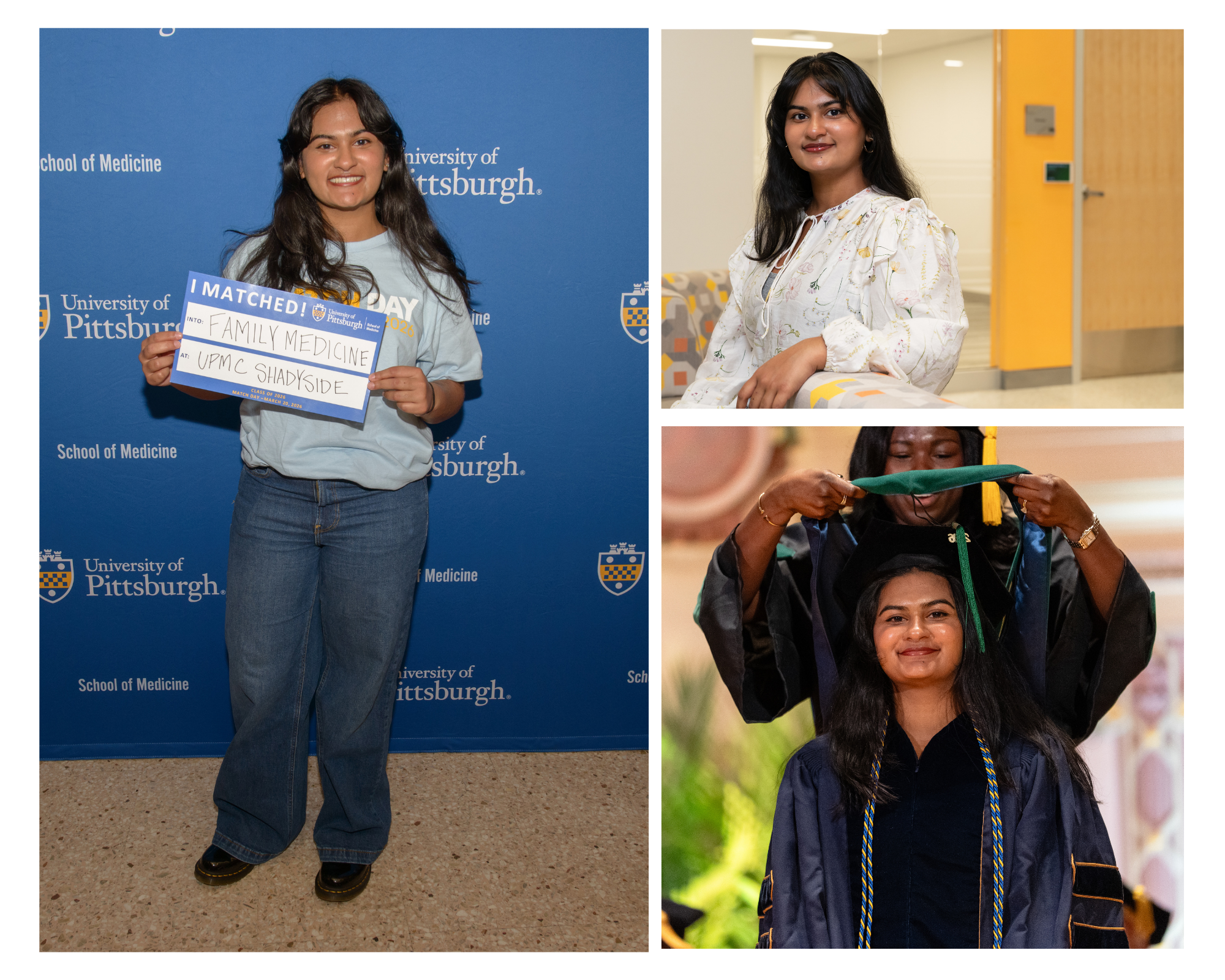
On May 17, the University of Pittsburgh School of Medicine’s Primary Care Accelerated Track (PCAT) program celebrated the graduation of its first student, Amrita Mani.
Mani’s graduation represented not only her individual success, but the evolution of the PCAT program since its launch in 2023 and a new era of prioritizing primary care in the School of Medicine.
PCAT is an accelerated program offered in partnership with UPMC Medical Education that enables students who are interested in internal medicine, family medicine or pediatrics to graduate from medical school in three years.
“This program is really important, especially for Western Pennsylvania. We have a high proportion of geriatric and underserved patients that need primary care,” said Amanda Casagrande, assistant professor of family medicine, School of Medicine, and director of the PCAT program.
“This initiative is Pitt saying, ‘We care about primary care.’ We’re putting money, effort and time into developing future primary care physicians for our community, and that is a big deal.”
Mani began considering primary care while working at a federally qualified health center in her home state of North Carolina.
“I could see myself doing something very similar in the future. I’ve always been someone who likes a lot of different things, so I didn’t go into medical school with a specific interest. I wanted to explore everything and keep it as broad as I could,” she said.
That curiosity is what drew her to the PCAT program, and specifically to family medicine.
“With pediatrics you can only serve kids, and with internal medicine you can only serve adults. Family medicine lets you do both. I knew I wanted to see patients of all ages,” she said.
Students in the PCAT program build relationships at UPMC primary care clinics as early as their first week of medical school through the program’s longitudinal clinical experience. Students are required to spend time at the clinics they are paired with every other week throughout the duration of medical school.
“They get to know their future residency faculty members early on, when they’re just learning about basic sciences and how to talk to patients and do skills. The students see them as the physicians they want to become,” said Casagrande, who is also medical director of the Pitt Vaccination and Health Connection Hub.
For Mani, who was assigned to UPMC Shadyside Family Medicine Residency Program, seeing patients with the clinic’s residents helped to confirm that she was on the right track.
“The afternoons at UPMC Shadyside let me check in regularly about if I could see myself joining the field of family medicine. Those visits confirmed that I could see every type of general medicine, ranging from women’s health to small procedures and injections and seeing kids. The variety really solidified it for me,” she said.
In their final year, PCAT students can interview to match at five UPMC residency programs, which rank them favorably.
Mani experienced a full circle moment when she matched into UPMC Shadyside’s Family Medicine Residency Program.
“I really loved Shadyside, so that was the program I truly wanted. It was so nice knowing many of the people there, having met the faculty and residents—being able to see if you’d be a good fit before even starting,” she said.
Casagrande and PCAT Program Coordinator Karen Musto are using the lessons learned and student feedback from PCAT’s first three years to shape the future of the program.
After their first year of medical school, PCAT students participate in a summer course developed specifically for the PCAT program, where they focus on translation research, community medicine and health systems science. As a part of this course, the students spend time in the School of Public Health’s Bridging the Gaps community health internship program.
After PCAT’s first year, students reported that they wanted more time in the communities that they were working with through the program.
“Now, the sites that they’ll be at for Bridging the Gaps are the same sites that they are at for their Community Alliance Program. So they have continuity, through the entire course of their first year into the summer and beginning of their second year,” said Casagrande.
Musto and Casagrande have also worked to implement study sessions where PCAT students and their coaches create individualized plans to prepare for their United States Medical Licensing Examination Step 1 exams, as well as peer tutoring sessions.
In addition, Mani’s personal experience has been a model for refining PCAT.
“It was easy to see how much my voice actually mattered. What I said could genuinely shape things, because my experience was one of the only ones they had to go on,” said Mani.
Mani wants future medical students who are interested in the PCAT program to know that “you will have incredible support, mentorship and a lot of resources at your fingertips.”