By Kat Procyk
Photography by Rayni Shiring, University of Pittsburgh

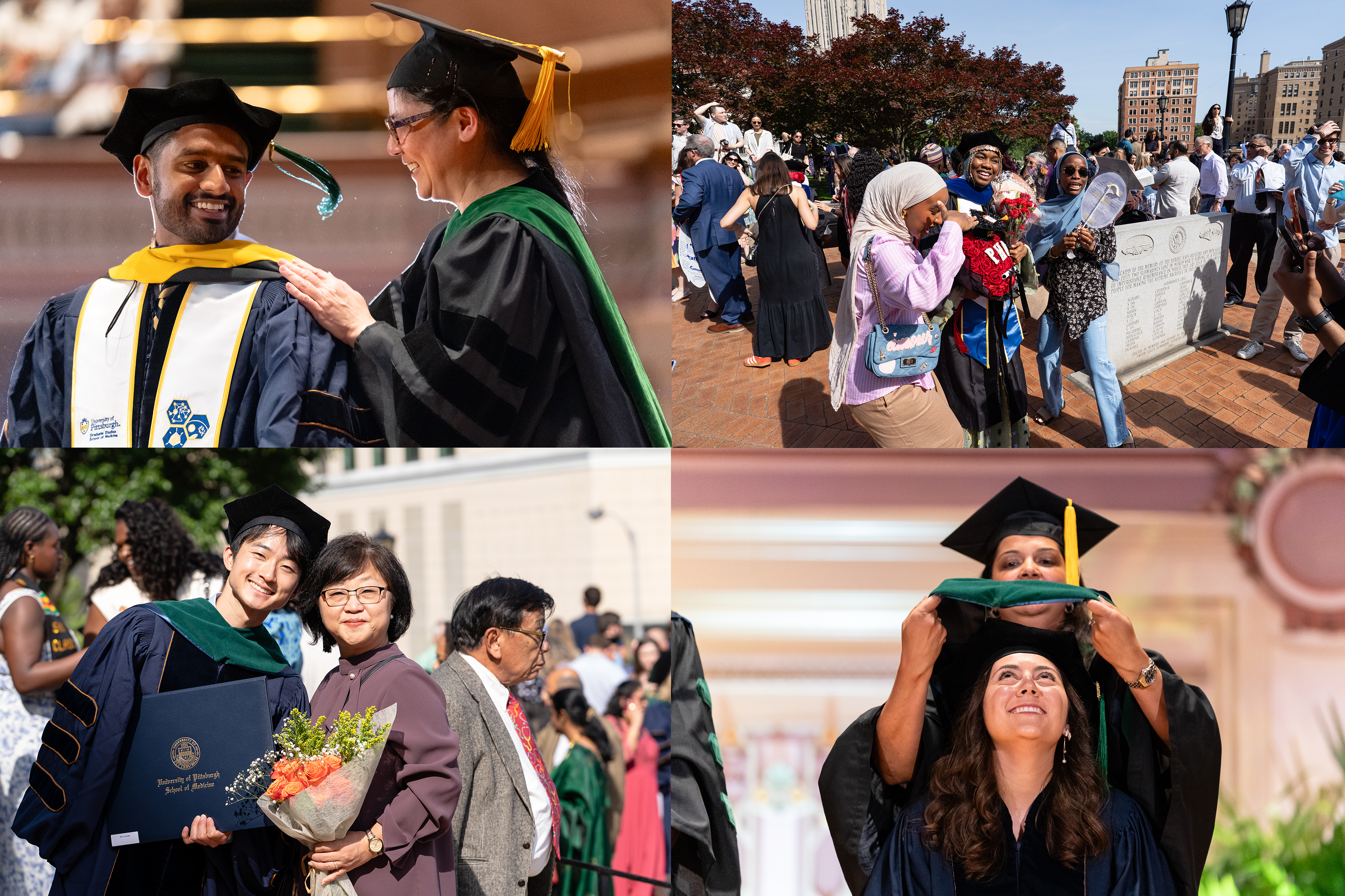
The 139th graduating class of the University of Pittsburgh School of Medicine celebrated Diploma Day on May 17, 2026, at Soldiers and Sailors Memorial Hall.
Cheered on by family and friends, the 139th graduating class from the University of Pittsburgh School of Medicine stepped into their futures as physicians and innovators on May 17, 2026, for Diploma Day at Soldiers and Sailors Memorial Hall.
The school awarded 174 medical degrees (MD), 70 doctoral degrees and 113 master’s degrees.
MD graduates matched to residency programs in 25 states, with 59 remaining in Pennsylvania, in the areas of primary care (38%), hospital-based (29%) and surgical (33%). Forty-five of them will make up 11% of UPMC’s incoming resident class.
Pitt uniquely houses a top-ranked medical school within walking distance of its nursing, dental medicine, public health, pharmacy, and health and rehabilitation sciences schools, creating exceptional opportunities for interprofessional research and education. This class had the first graduate of the Primary Care Accelerated Track, a program that enables students who are interested in internal medicine, family medicine or pediatrics to graduate from medical school in three years.
Anantha Shekhar, senior vice chancellor for the health sciences and John and Gertrude Petersen Dean, School of Medicine, reflected on the monumental contributions Pitt has made to health care such as the development of the polio vaccine in Jonas Salk’s lab, the nation’s first paramedic service, Freedom House, and advances in modern organ transplantation, while highlighting how the University continues to build on this legacy by addressing health care disparities through programs in underserved communities and initiatives like BioForge, which will help make expensive medicines more affordable and accessible.
“You may choose to get into extremely complex research careers; you may get into extremely complex surgical careers, or you may get into the extremely complex psychosocial environment of primary care,” Shekhar said in his salutation. “Each of those will challenge you with everything you’ve learned and everything we hope to have imparted to you. What we hope for is that not only are you going to do amazing things—things that we’ll be proud of—but wherever you go, you remain a leader and make a difference.”
Graduate studies students demonstrated remarkable scholarly productivity during their time at Pitt, including having 275 publications in peer-reviewed journals—with Pitt students listed as first author on half of those—100 published conference abstracts and nearly 400 presentations at national and international science conferences.
For this year’s graduating class, 37% accepted postdoctoral positions; 16% are continuing their education through medical scientist training programs and 17% accepted biomedical science-related industry positions. The remaining students are finalizing their next career steps.
In her keynote address, Kimberly D. Manning, professor of medicine (Division of General Internal Medicine), Emory University School of Medicine, said graduates needed to focus on gratitude for reaching this celebratory moment.
“Hear me now when I say you’re worthy,” she said. “Even as you strive and look ahead, please look around at who’s grateful you’re alive, and when you feel you’re lacking and don’t know where to start, take an inventory of your tiny joys and let them fill your heart. Life is surely going to life—but love is surely going to love.”