
By Rachana Senthil
Photography by Alex Mowrey/University of Pittsburgh
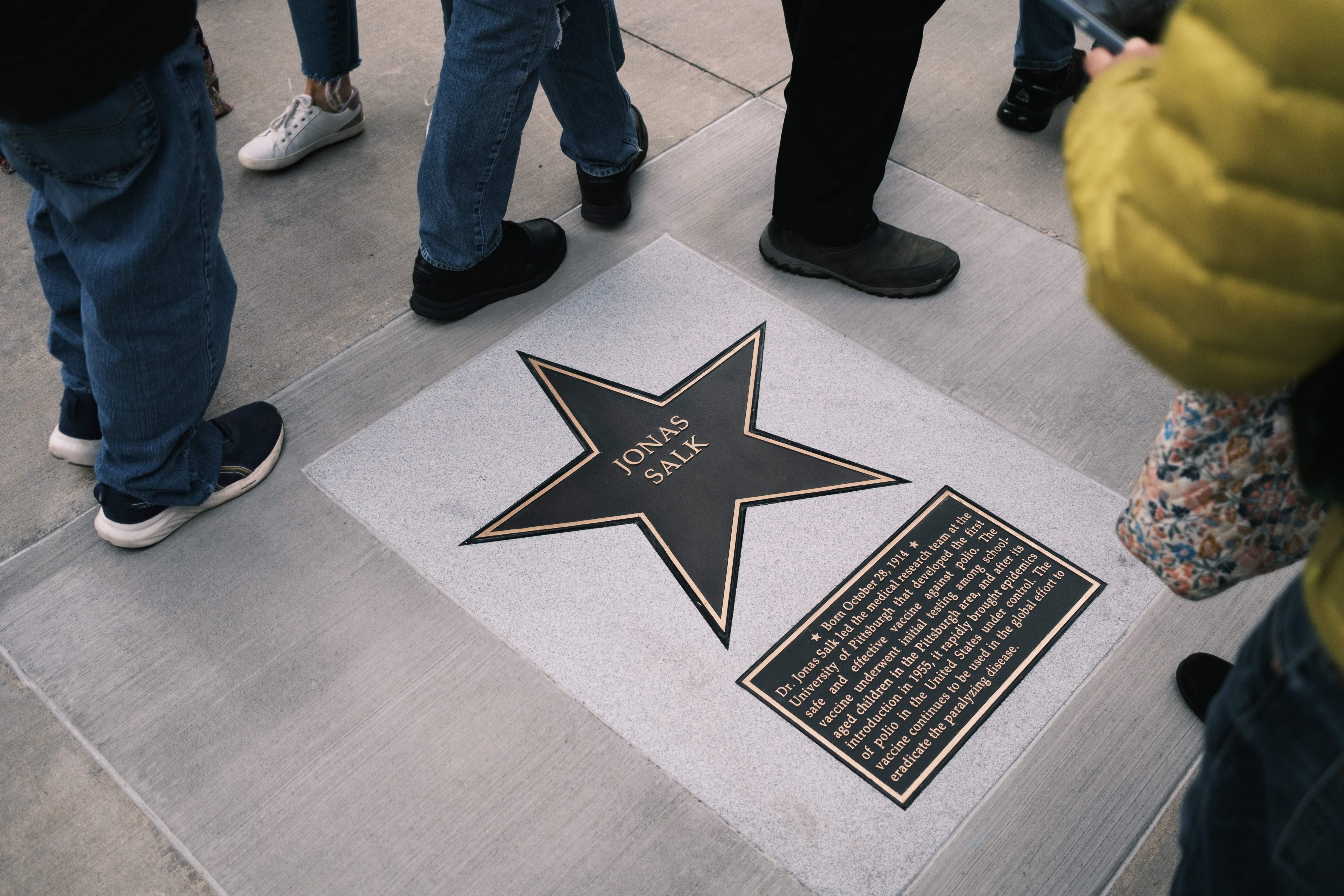
Jonas Salk, who developed the groundbreaking polio vaccine at the University of Pittsburgh, was among the first Pittsburghers honored as the city unveiled its new Walk of Fame in the Strip District on Oct. 20.
The new landmark, featuring bronze stars and plaques embedded in the sidewalk along Smallman Street at the Terminal building, celebrates 10 iconic individuals whose contributions have shaped Pittsburgh's cultural, scientific and musical legacy. The inductees include George Benson, Nellie Bly, Andrew Carnegie, Rachel Carson, Roberto Clemente, Michael Keaton, Fred Rogers, Andy Warhol and August Wilson. The event, featuring Keaton as a special guest, was a proud moment for Pittsburgh as it recognized figures whose work had lasting impacts.
In 1948, Salk became the director of the Virus Research Laboratory at the University of Pittsburgh School of Medicine, where he and his team conducted polio research, developing the first safe killed-virus polio vaccine. On April 12th, 1955, it was announced to the world that the Salk vaccine was found to be safe and effective.
Before that, polio outbreaks killed or paralyzed millions. Patients often had to use braces, crutches, wheelchairs or iron lungs—assistive devices they might depend on for their entire lives. With the lack of effective treatment, communities lived with anxiety and fear, making the need for a vaccine urgent.
The vaccinations started in Pittsburgh, with Salk, his research team and local schoolchildren being the first people to be inoculated. The Pittsburgh community became an integral part of leading the national transformation in public health.
Salk’s legacy forever changed the scientific community, but his contribution was also deeply humanitarian. He refused to patent the vaccine, famously asking, “Could you patent the sun?” He wanted to ensure its widespread use to keep communities safe. His work, which also earned him the Presidential Medal of Freedom, continues to inspire researchers.
His induction into the Pittsburgh Walk of Fame pays tribute to his medical breakthrough as well as the contributions of Pitt Health Sciences to the world.