
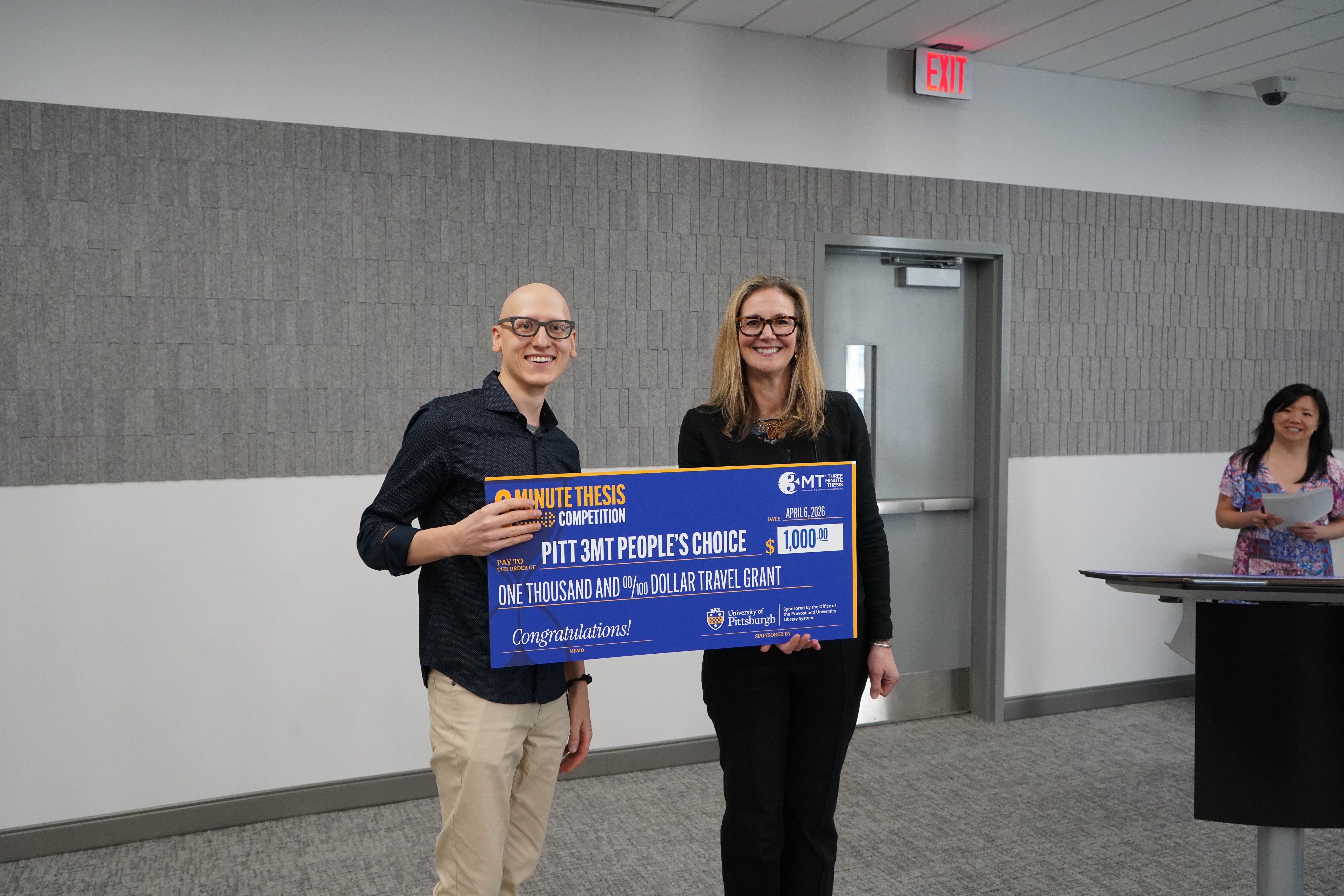
Caption: Keith Kaufman (left), graduate neuroscience student and winner of the medical school's Three Minute Thesis competition, with Amanda Godley, Vice Provost for Graduate Studies.
The ability to clearly communicate the relevance of science to the lay public is not just a nice career skill for researchers to have. It’s critical if they hope to champion science.
Thirteen graduate students from the medical school stepped forward on March 20 to demonstrate their ability to translate science into plain English at the school’s Three Minute Thesis (3MT) competition. They were charged with taking three minutes or less to effectively explain their research and engage a nonspecialist audience, using only a single slide.
Keith Kaufman, a graduate neuroscience student at the School of Medicine, nabbed first place and $1,000 with his talk, “We’re Not Always the Best Listeners: How Dynamic Brain States Shape How We Hear.”
“None of us are born with the knowledge we use in our research, yet it’s easy to forget what it’s like to learn it for the first time,” says Kaufman. “Like many scientists, I spend most of my time working with data. This competition challenged me to turn that data into a clear, compelling story that anyone can understand—which is not only fun, but essential. After all, data collection without dissemination has no real impact.”
Lizzie Giacobe, a graduate student in microbiology and immunology, took both the Runner Up and People’s Choice awards with her presentation, “Protecting Pregnancy: How Bacteria Break In,” winning a $1,500 total for the two awards.
Kaufman went on to represent the school in the University-wide competition in April; there he garnered People’s Choice ($1,000) and Runner Up ($500) awards. The first-place winner was Youjia Wang of the School of Nursing, for “Cancer Has Two Patients.”
“This is an important learning moment for our students. For some, it’s when they realize they do need communication skills, and they do need to learn how to communicate with nonspecialists,” says Natalia Guimaraes, career services specialist with Graduate Studies in the School of Medicine.
3MT originated at the University of Queensland in Australia in 2008. Today, competitions are held in more than 900 universities across more than 85 countries.