Photos courtesy of Leidos

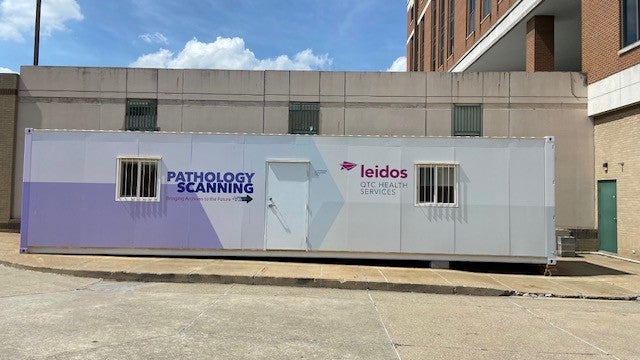
The shipping container parked behind UPMC Shadyside Hospital may not look high-tech, but researchers hope that what’s happening inside can lead to better disease diagnosis. And having that technology housed in a container means it can hit the road easily.
The container is called the ScanVan™, and it is in Pittsburgh as part of a partnership between the technology company Leidos and the University of Pittsburgh’s Computational Pathology and AI Center of Excellence (CPACE) team.
“The ScanVan is a container that is relocatable, so it can be placed at a hospital for a few months, then relocated with only a few days’ work to set up at another location,” said Todd Minnigh, vice president of XMS at Leidos QTC Health Services. “The purpose is to scan thousands of microscope slides from hospital archives. These digitized images can then be used for education, clinical research and artificial intelligence (AI) development.”
Matthew Hanna, associate professor of pathology, School of Medicine, and director of AI operations at CPACE, explained: “Pathology is in an evolutionary stage. Similar to what Xerox did to digitize paper, whole slide scanners can now digitally transform patient tissue processed in the laboratory and traditionally reviewed on a glass slide in a microscope, into a digital slide/image, called a whole slide image.”

Pathology labs process millions of slides per year, and are required to store them, sometimes for decades.
“Pathologists routinely review patients’ previous material as part of their clinical workup, and those glass slides may be archived, depending on how far back they were in the patient’s journey,” Hanna explained. “Digitizing a hospital’s pathology glass slide archive is an incredibly arduous task that would otherwise cost many millions of dollars to support. The ScanVan initiative is stress-testing the operational throughput in digitally scanning pathology labs’ archival glass slides in a lean manner, and also presenting an option for pathology labs to scan their glass slide archives for clinical purposes.” The slides are de-identified to protect patient privacy.
One wrinkle, Hanna said, is that “there are different manufacturers and models of these glorified Xerox machines–the whole slide scanners–and some specimen types may be best digitized on one device versus another.”
To address that, CPACE is working collaboratively with Leidos on developing an AI triage workflow to automate and expedite the scanning process operation, he said.